

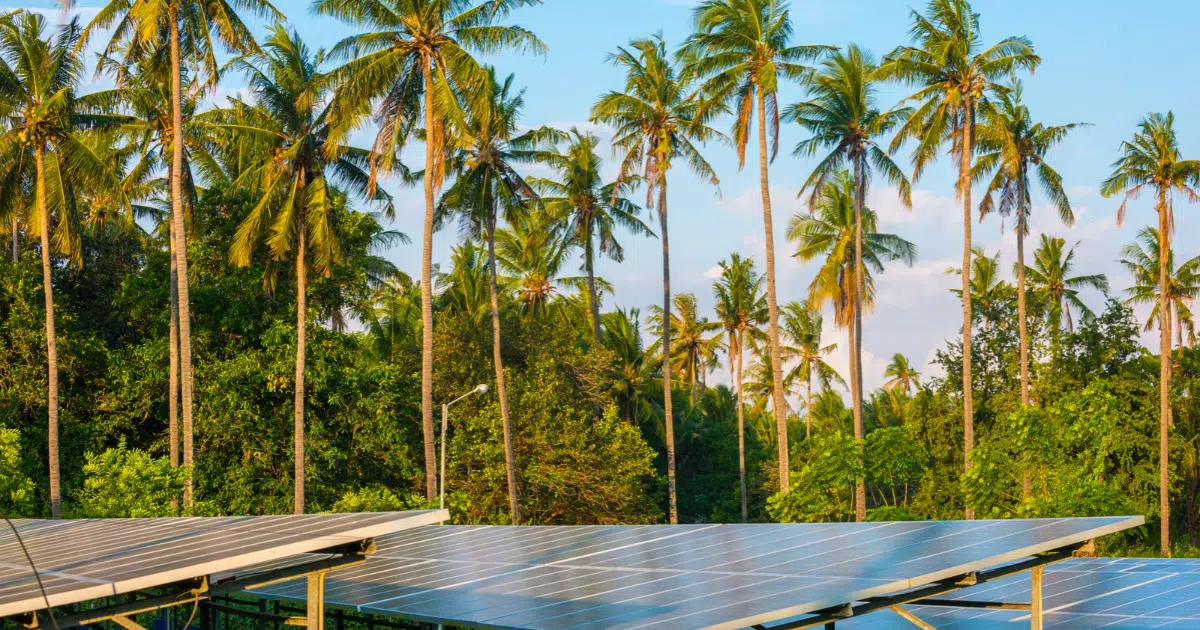
Philippines, Indonesia, Vietnam Join Forces To Accelerate Solar Shift In Off-Grid Islands
- November 20, 2026
Table of Contents
The Philippines has joined Indonesia and Vietnam in a regional partnership to accelerate the replacement of diesel-fired power generation with solar photovoltaic (PV) and battery energy storage systems in remote and island communities, as the country seeks to reduce its dependence on costly oil-based electricity.
The initiative was launched during the “Powering the Islands and Remote Communities through Solar and Battery Storage” event at the Philippine Hub on the sidelines of the 31st United Nations Climate Change Conference (COP31) in Antalya, Turkey.
The partnership aims to mobilize investments and strengthen regional cooperation to develop more affordable, reliable, and climate-resilient electricity systems in areas where extending conventional power infrastructure remains challenging.
The agreement comes as the Philippines continues to rely heavily on oil-fired generation to supply electricity to off-grid communities. Department of Energy (DOE) data showed that 421 of the country’s 447 off-grid power plants, or about 94 percent, were still dependent on oil as of December 2025.
The dependence exposes remote communities to fluctuations in international fuel prices and contributes to higher electricity generation costs compared with areas connected to the main power grids.
It also places pressure on the Universal Charge for Missionary Electrification (UCME), a subsidy collected from on-grid electricity consumers to help cover the cost of supplying power to remote areas.
The UCME currently stands at ₱0.3397 per kilowatt-hour (kWh). For a household consuming 200 kWh monthly, the charge translates to an additional ₱67.94 on its electricity bill.
Long-Term Planning
Under the regional partnership, the three countries intend to move beyond individual demonstration projects and pursue coordinated, long-term energy planning to accelerate the deployment of solar and battery storage systems.
The initiative will involve developing supportive government policies, establishing financing mechanisms, modernizing electricity grids, and strengthening technical capabilities to ensure projects can move from planning to implementation.
“Island communities should not have to depend indefinitely on expensive and volatile diesel generation to secure reliable electricity. Solar and battery storage offer a practical pathway to reduce costs, strengthen energy independence, and build resilience,” Asian Photovoltaic Industry Association (APVIA) Steering Committee chairperson Tetchi Capellan said.
“Through this partnership, we want to bring countries, industry, and investors together to turn these opportunities into implementable projects,” she added.
Capellan said replacing diesel generation with solar power and battery storage could reduce recurring fuel expenses while improving the reliability of electricity supply in remote areas.
Lower generation costs could also help ease the financial burden of subsidizing missionary electrification, which is partly shouldered by consumers connected to the country’s main grids.
DOE Undersecretary Felix William Fuentebella, who led the Philippine energy delegation, said the government was committed to incorporating island electrification into its renewable energy procurement strategy.
“The Department of Energy is serious about integrating island electrification under the Green Energy Auction,” Fuentebella said.
The Green Energy Auction program allows the government to procure renewable energy through competitive bidding, providing developers with a mechanism to secure a market for their projects.
Cost-Saving Potential
Existing projects demonstrate how solar-plus-storage systems can reduce the cost of supplying electricity to isolated communities.
On Cobrador Island in Romblon, a 30-kilowatt solar and battery hybrid facility has reportedly reduced electricity generation costs by 50 percent, from $0.47 to $0.24 per kWh.
The system has also extended electricity service from eight hours to 24 hours daily, demonstrating how combining renewable generation with battery storage can address both affordability and reliability concerns.
The project provides a potential model for other Philippine islands that remain dependent on diesel generators and face high fuel transportation and operating expenses.
Regional experiences offer further evidence of the economic benefits of the transition. Research by Indonesia’s Institute for Essential Services Reform estimates that solar PV combined with battery storage can generate electricity at about one-third of the cost of diesel-fired generation under the conditions assessed.
Replacing diesel consumption used for electricity generation across Indonesia could generate savings of up to 17.2 trillion rupiah.
In Sumbawa, a modeled energy transition scenario projects a 21.3 percent reduction in generation costs and a 73 percent decline in emissions by 2035.
The experience highlights the potential for renewable energy systems to deliver both economic and environmental gains, particularly in island economies where diesel remains a major source of electricity.
The regional discussion also featured Saint Kitts and Nevis as an example of how island nations could pursue a broader energy transition.
A preliminary roadmap developed by the Greening the Islands Foundation projects that renewable energy could account for 83 percent to 100 percent of the Caribbean country’s electricity generation by 2035.
The transition could generate approximately $34 million in annual savings from reduced diesel consumption.
The roadmap identifies solar and battery storage installations, geothermal development, and grid interconnection as key components of the proposed transition.
Source:
https://www.philstar.com/business/2026/11/17/2570537/philippines-indonesia-vietnam-team-solar-push
https://business.inquirer.net/620507/ph-vietnam-indonesia-team-up-on-island-solar-program


