Green Energy, Steep Costs: The Netherlands’ Reality Check
- October 30, 2025
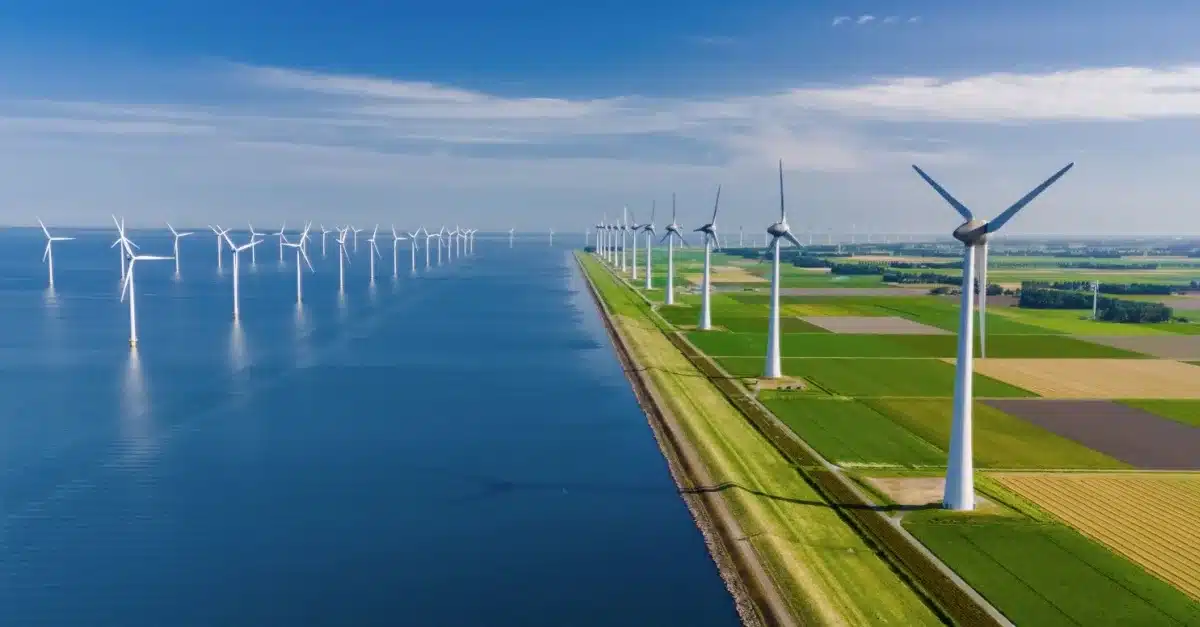
The Netherlands has led the way in Europe’s clean energy transition, rapidly electrifying its roads and rooftops. With the continent’s highest number of charging stations per capita and more than a third of homes now powered by solar panels, the nation has traded its North Sea gas for wind and sunlight. Offshore wind farms are poised to take center stage by 2030, marking a bold shift toward a fully renewable future.
However, a serious problem shadows the Netherlands’ green success story. The nation’s electricity grid is straining under the weight of its renewable energy (RE) boom as demand and supply grow faster than infrastructure can adapt. Known as grid congestion, this strain resembles a traffic jam where an overload of power, from either high demand or surplus solar and wind energy, overwhelms the system and slows progress.
The roots of the problem lie in an outdated grid built for another era. Designed around a handful of large, gas-fired power plants, it relied on thick transmission lines near those hubs that tapered into smaller ones toward homes. Today’s RE surge has flipped that flow, with solar panels and wind farms feeding power from the edges of the network, overwhelming the smaller lines never meant to carry such heavy loads.
Belgian energy expert Professor Damien Ernst warned that the Netherlands faces a costly grid crisis after years of underinvestment in power transmission and distribution. He noted that bottlenecks now stretch across the country and could take billions and several years to fix.
Ernst added that this challenge extends across Europe. “We have an enormous amount of solar panels being installed, and they are installed at a rate that is much, much too high for the grid to be able to accommodate,” he said.
(Also read: Powering the Future: A Diverse Mix for a Strong Energy Transition)
When green growth outpaces the grid
The NL Times reported that the Netherlands experienced 27,341 power outages in 2024, marking a sharp 17% rise above the five-year average.
In 2024, around 2.4% of Dutch electricity users experienced power interruptions. Unplanned outages, often the result of accidental cable damage during construction, lasted an average of 70 minutes, while planned maintenance cuts extended to nearly four hours as crews worked to upgrade the aging grid. Grid operators anticipate more planned power cuts in the years ahead as the Netherlands races to modernize its overstretched electricity network.
At Eneco’s Rotterdam headquarters, one of the Netherlands’ largest energy producers manages its operations through a sophisticated control system known as the “virtual power plant.” Acting as the brain of the network, it helps stabilize the grid by curbing wind or solar output when generation surges and automatically reducing power use among customers who opt for lower rates in exchange for flexibility during peak demand.
Across the country, households and businesses are finding it harder to secure new or upgraded grid connections. Homeowners eager to install heat pumps or charge electric vehicles (EVs) face delays. Even new housing projects are being stalled as the strained power network struggles to accommodate additional demand.
Thousands of Dutch households and businesses now face years-long waits to connect to the grid, whether to draw more power or feed in RE. National grid operator TenneT reports that about 8,000 companies are waiting to supply electricity, and another 12,000 are seeking approval to increase their consumption.
TenneT is set to pour about €200 billion (US$235 billion) into reinforcing the Netherlands’ strained electricity network, including 100,000 kilometers of new cabling by 2050. The upgrade aims to expand capacity severalfold to keep pace with the nation’s RE shift.
But progress is slow. Major grid projects can take up to a decade to complete, with most of that time consumed by permits and land rights rather than construction. As the energy transition outpaces infrastructure expansion, each new connection request only lengthens the waiting list.
Heavy economic impact
A BCG and Ecorys study estimates that grid congestion costs the Dutch economy as much as €40 billion (US$46.5 billion) each year.
Meanwhile, the second Progress Report of the National Grid Congestion Action Program (LAN) reveals that 90% of Dutch businesses face direct or indirect impacts from grid congestion. These constraints hinder expansion, RE projects, and fleet or industrial electrification, posing a significant challenge to the country’s overall economic performance.
Independent advisor Ynse De Boer points out that grid constraints are not just a Dutch problem, but a Europe-wide challenge. In Germany, record renewable output is often curtailed because the network cannot move electricity from the north to high-demand southern regions, costing around 19 terawatt-hours (TWh) in 2023 alone. France struggles to integrate decentralized solar and wind alongside its nuclear fleet, while the UK faces rising demand from EVs and home electrification, with peak loads projected to jump 50% by 2035 if grids and storage aren’t upgraded.
“The stakes are high: grid congestion is not just about energy – it’s about economic growth, environmental progress, and Europe’s ability to lead the global transition to clean energy,” he wrote.
Companies are unable to expand operations due to limited capacity. “Grid congestion is putting the future of the Dutch chemical industry at risk… while in other countries it will be easier to invest,” Dutch Chemical Association President Nienke Homan cautioned.
Research by Savills shows that 66.4% of Dutch logistics properties are in areas with insufficient grid capacity, 50.3% face congestion when feeding power back into the network, and 46.4% are affected by both. Experts say these limitations are slowing electrification and threatening the Netherlands’ competitiveness as a leading industrial and logistics hub.
Energy availability is increasingly shaping logistics site choices. Properties in areas with constrained grid capacity or limited ability to feed power back face higher vacancy rates, highlighting that long-term occupancy is strongly linked to reliable electricity access.
According to Strategic Energy Europe, tangible results are expected only in the medium term, although numerous initiatives are in motion. Meanwhile, it emphasizes the need for a cultural shift in electricity consumption and closer collaboration between government, industry, and the public.
(Also read: Can Tackling Climate Change Truly Drive Growth & Equality?)
Fast-tracked but fragile
Kees-Jan Rameau, chairperson of the Management Board and Interim CEO of Eneco, acknowledged that after the 2015 Paris Agreement, “we were very much focusing on increasing the renewable power generation side. But we kind of underestimated the impact it would have on the power grid.”
At the Dutch Ministry for Climate Policy and Green Growth, Minister Sophie Hermans’ office said, “In hindsight, the speed at which our electricity consumption has grown might have been collectively underestimated in the past,” adding that demand often emerges unpredictably across households and businesses.
To address this issue, the ministry highlighted its “National Grid Congestion Action Plan,” which aims to speed up grid expansion by streamlining the permit process.
What lessons can the Philippines draw from the Netherlands’ experience? A Daily Tribune editorial noted that while RE is celebrated in global forums like the UN Climate Change Conference, its promises often fall short in practice.
“The Dutch, despite their vast natural gas reserves, have stubbornly plunged into strict green energy policies — only to find themselves bowing to the folly of renewable energy,” it stated. “Thus, the RE boom has become unsustainable because the electricity systems of every nation are built for conventional electricity supply.”
Regarding the Philippines’ own RE push, the editorial issued a stark warning, urging caution as the country charts its path toward decarbonization. “For a developing nation like the Philippines to be forced to get into the expensive grid adjustment would be nothing less than criminal,” it asserted. “While enormous resources are lost to the corrupt practices of its government leaders, the shift to RE threatens to add roadblocks to development through unnecessary expenses.”
Sources:
https://www.bbc.com/news/articles/cn40y9yxkgvo