

When Clean Energy Isn’t So Clean: Talim Island & the Masungi Georeserve Pay the Price for Wind Power
- September 9, 2026
Table of Contents
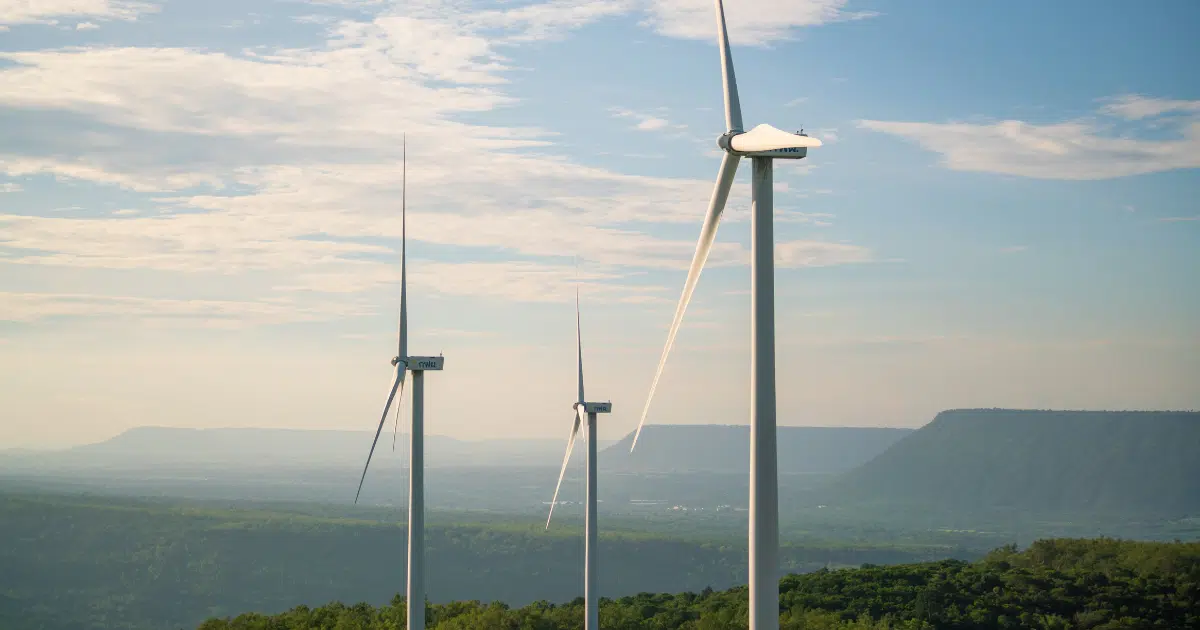
The 218.75-megawatt (MW) Talim Wind Power Project covers roughly 3.4 million square meters across Binangonan and Cardona, making it one of the major wind energy developments being pursued in the country.
But in March, fisherfolk and coastal residents around Laguna de Bay marched in protest against the project, citing its potential impact on communities and biodiversity. The group estimates that more than 40,000 residents and fisherfolk could be affected by the project, which is being developed by the Island Wind Energy (IWEC), a subsidiary of Singapore-based Vena Energy.
More recently, Caritas Philippines, the humanitarian and advocacy arm of the Catholic Bishops’ Conference of the Philippines, has joined in the dissent.
“We stand with the residents, fisherfolk, and environmental advocates of Talim Island who have raised serious concerns about the Talim Wind Power Project,” declared Bishop Gerardo Alminaza, president of Caritas Philippines.
The prelate pushed for an immediate suspension of the project until environmental requirements are met, scientific assessments are completed, information is fully disclosed, and affected communities are meaningfully consulted.
(Also read: Government Backs Geothermal Expansion With ₱10-B Exploration Facility)
A Dispute at the Masungi Georeserve
A separate wind development is also being pursued across parts of Tanay and Antipolo. Rizal Wind Energy Corp. (RWEC), also a Vena Energy affiliate, has an environmental clearance for a 603-MW facility planned across 13 mountain ridges. The project’s DOE-approved service contract covers nearly 26,000 hectares in Rizal and Quezon, while the proposed turbine sites occupy an area comparable to about 770 football fields.
The development has drawn scrutiny over its proximity to protected landscapes. The turbine sites identified fall within three protected areas, with the Masungi Karst Conservation Area adjacent to the project’s western edge.
In a November 2023 drone survey, the Masungi Georeserve Foundation Inc. (MGFI) documented what it said were construction activities for 12 wind turbines on the Tanay side of the sanctuary. The footage showed drilling rigs, heavy equipment, workers and temporary structures inside the wildlife sanctuary.
The discovery marked an unusual escalation. Drone patrols in the reserve’s remote areas had previously uncovered forest fires and tree-cutting, but drilling and active construction were a first.
MGFI sought to stop the development in 2025. But the Department of Environment and Natural Resources (DENR) rejected the petition in March 2026, but the project remains suspended even as its Environmental Compliance Certificate (ECC) remains valid.
Environmental Impact
In Talim Island, municipal inspection reportedly found earthmoving and site grading already in progress, despite some required environmental documents not being available on-site.
For 76-year-old resident Lolita Silahis, the mountain behind her community had long protected it from floods, with clear runoff flowing into the lake even during heavy rains and typhoons. But in 2025, a typhoon sent a muddy flash flood through her home.
Residents later learned that parts of the mountain had been cleared and flattened for the wind power development, removing forests that had helped shield the community from flooding.
“The construction of the windmill project on our island has already resulted in unprecedented flooding in coastal communities and biodiversity loss,” said Ronnel Arambulo, vice chairperson of the fisherfolk organization, Pambansang Lakas ng Kilusang Mamamalakaya ng Pilipinas (PAMALAKAYA).
At the Masungi Georeserve, the concern extends beyond the immediate footprint of the project. Conservation biologist Tristan Montemor explained that the karst formations of the Upper Marikina River Basin act like a natural sponge, absorbing rainwater from the surrounding mountains and releasing it slowly. That buffering system helps regulate water flows and provides a vital safeguard for communities downstream, reaching as far as Metro Manila.
He warned that further fragmentation from turbines, roads and related infrastructure could worsen downstream risks of flooding and drought.
“For these megastructures to be built in protected areas, it would really be very difficult for us to restore a huge portion of the ecosystem, if not impossible,” he stressed.
Livelihoods at Risk & Lack of Community Input
The development could also put fishing grounds and farmland at risk, potentially affecting families who depend on these resources for their livelihoods. The bishop warned the project’s scale must be considered alongside its potential impact on Talim Island communities that rely on fishing, farming and other natural resources.
Residents said they were unaware of the development until heavy equipment arrived and workers began clearing parts of the mountain on Talim Island.
Jayson Villones, 31, a lifelong island resident and co-convenor of the opposition group, Kapit sa Talim, maintained that the summit of Mt. Tagapo had never been accessible to vehicles before construction began.
He eventually verified the development after seeing videos about it posted by a local YouTube creator. He also said he was not aware of any public consultation on the wind project being conducted in his barangay.
“The right of the people to know about this project was violated,” he stressed. His group is calling for the release of hazard assessments, permits, and records of consultations used in approving the wind project.
Meanwhile, Alminaza recognized the developer’s community initiatives, such as providing 1,000 school chairs, but said these efforts “cannot substitute for environmental compliance, disclosure and meaningful participation.”
A similar dispute has emerged at Masungi Georeserve, which maintained that it was never consulted about the proposed wind development.
“We were really surprised because we were not informed or consulted as big stakeholders in this area and conservationists, and supposedly partners of the DENR in this area,” stated MGFI co-founder Billie Dumaliang.
MGFI described the activity uncovered inside Masungi as a “disturbing violation” of a 1993 DENR order that prohibits exploration, development and exploitation activities within the area.
Concerns Surround Other Wind Projects
At the summit of Mt. 360 in Tanay, Rizal, a cleared section of the mountain now stands alongside a wind turbine tower being built as part of Alternergy’s Tanay Wind Power Project.
A resident of Barangay San Andres, who asked not to be identified for security reasons, said clearing began in January 2025. By the start of the rainy season, streams flowing toward the barangay had turned muddy, which the resident attributed to the mountain clearing for turbine construction.
In Samar, another Vena Energy-backed development is facing opposition over its proposed location. Gemini Wind Energy Corp. plans to install 37 turbines in and around the Calbayog-Pan-as Hayiban Protected Landscape in Calbayog City. Thirteen of the turbines would be within the protected area.
Efren Reyes, a village chief and member of the protected area management board, insisted that he did not fully understand the documents he was asked to sign and that consultations should have been conducted in the local language.
Meanwhile, academic Harold Mercurio of the Save Calbayog Rivers Foundation said the community was caught off guard by the speed of the project’s approval. The group has since filed objections and led a petition opposing the development.
(Also read: DA, DOE Move To Shield 3 Million Hectares Of Farmland From Solar Projects)
Clean Energy, But At What Environmental Cost?
With the Philippines targeting a RE share of 35% by 2030 and 50% by 2040, the government is accelerating private-sector energy developments to expand clean power capacity.
Wind currently makes up less than 1% of the country’s electricity mix. But if projects in the pipeline are completed, it could overtake geothermal and hydropower to become the Philippines’ largest RE source.
But according to Eduardo Espejon of Northwest Samar State University, the environmental impacts of wind development can become more pronounced when forests are cleared on steep terrain. Without vegetation and intact soil to absorb and slow rainfall, water rushes downhill, carrying loosened soil with it and increasing the risk of erosion and flooding in communities below.
Espejon said restoring a heavily cleared area to a healthy forest is a long-term process. Even with appropriate species, proper rehabilitation and sustained protection, full ecological recovery can take at least 20 to 40 years.
Global Forest Watch data shows Rizal lost more than 5,000 hectares of tree cover from 2001 to 2025, with recent years among the highest on record.
Meanwhile, community groups say their opposition is not to RE itself, but to where these developments are being built, particularly in environmentally sensitive areas.
“We have to make sure that we do not lose our dependable and abundant supply of water, and that we do not compromise our forest cover in the next 50 to 100 years for the next generation,” highlighted Mercurio.
Alminaza emphasized that the Church supports the shift away from fossil fuels, but argued that the push for clean energy must not leave affected communities to bear the cost.
“Renewable energy must embody the same justice it seeks to advance,” he stressed.
Sources:
https://cbcpnews.net/cbcpnews/church-group-demands-halt-to-talim-wind-farm-construction/
https://prod-cms.doe.gov.ph/documents/d/epimb/01_luzon-committed_5_march-2025-pdf
https://www.rappler.com/environment/drilling-operations-windmill-project-found-masungi-georeserve


