

Philippines Bolsters Oil Supply Buffer As Global Risks Intensify
- April 16, 2026
Table of Contents
The Philippines has extended its oil supply buffer to an estimated 64 days while moving to tighten oversight of fuel storage and diversify sourcing, as global market instability and geopolitical tensions continue to threaten energy security.
The Department of Energy (DOE) reported that as of April 10, the country’s petroleum inventory stood at an average of 50.31 days, with additional secured orders equivalent to about 14 days, bringing total available supply to roughly 64 days. Energy Secretary Sharon Garin said the buffer is expected to remain stable under current conditions, with supply continuously replenished as stocks are consumed.
Breakdowns of the inventory show varying levels across fuel types. Gasoline stocks are sufficient for about 54 days, diesel for nearly 49 days, and liquefied petroleum gas (LPG) at around 36 days prior to recent replenishment orders. Kerosene reserves are significantly higher at over 100 days, while jet fuel and fuel oil stand at approximately 68 days and 46 days, respectively.
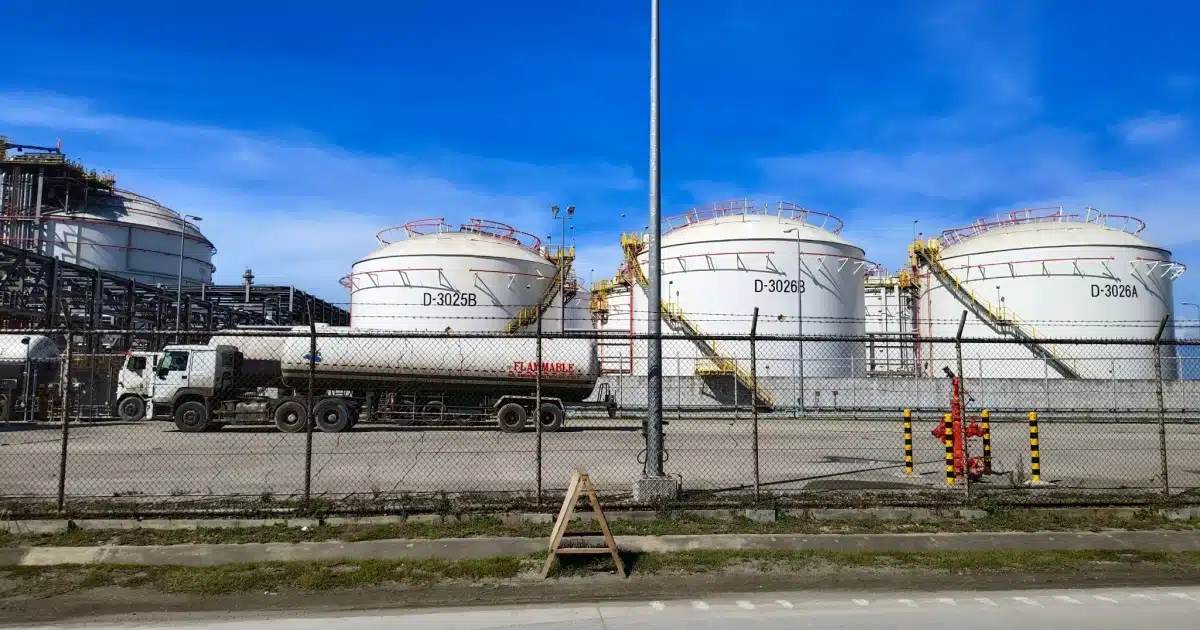
Despite calls to maintain a larger reserve of 90 to 120 days, Garin said infrastructure constraints prevent such expansion. “Storage capacity isn’t enough. Supply rolls over based on deliveries and consumption,” she told lawmakers, noting that stockpiling beyond current levels is not feasible under existing depot capacity.
Mandatory Storage Reporting
To address these limitations and improve supply visibility, the DOE has issued a new advisory requiring oil and gas companies to regularly disclose their storage capacities. The directive follows Executive Order No. 110, which declared a state of national energy emergency.
Under the policy, all downstream industry participants operating terminals and depots must submit data on total and available storage capacity. The DOE said the measure will allow closer monitoring of fuel inventories and enable faster response to potential shortages.
The advisory also authorizes the coordinated use of available storage facilities by the Philippine National Oil Company (PNOC) and its exploration arm to support national fuel requirements. Companies are required to comply, subject to technical feasibility, as part of a broader “whole-of-industry” approach to ensuring supply stability.
Non-compliance could lead to regulatory penalties, including suspension or cancellation of operating permits.
Diversification Strategy
Alongside inventory management, the government is expanding its pool of potential oil suppliers to reduce dependence on any single source. Garin emphasized that diversification remains the central strategy, citing accessible supplies from countries such as the United States, Canada, India, Brunei, and parts of South America.
The government is also exploring the possibility of importing oil from Russia, though no orders have been placed. The DOE is awaiting clarity from the United States on whether a sanctions waiver will be granted to allow such transactions.
“So far, there haven’t been any standing orders yet,” Garin said, adding that the timeline remains uncertain pending updates from the Department of Foreign Affairs.
She noted that supply reliability varies depending on contractual arrangements and the nature of suppliers. Some countries honor long-term agreements consistently, while others may impose restrictions depending on whether contracts are tied to state-owned or private entities.
Global Pressures
Recent fuel price rollbacks offered temporary relief to consumers, with diesel prices dropping by over ₱20 per liter, gasoline by more than ₱4, and kerosene by ₱8.50. These reductions followed a brief decline in global oil prices after the United States announced a ceasefire with Iran.
However, Garin warned that the downward trend is unlikely to persist. Renewed tensions in the Middle East, including risks surrounding key shipping routes such as the Strait of Hormuz, have already pushed prices upward again.
“We are really at the mercy of these countries. We are not even part of it,” she said, stressing the country’s vulnerability to external shocks.
She added that even if hostilities ease, elevated price levels could linger for months due to market adjustments and supply uncertainties.
Push For Energy Resilience
Beyond securing imports, the DOE is accelerating efforts to reduce reliance on volatile global oil markets. Initiatives include expanding rooftop solar adoption, promoting net metering, and increasing the share of renewable energy in the national mix.
The agency is also urging consumers to conserve energy through more efficient electricity and fuel use in homes and workplaces. Garin said these measures align with directives from President Ferdinand Marcos Jr. to strengthen energy resilience and protect domestic supply from geopolitical disruptions.
While the current inventory provides a buffer against immediate shortages, officials acknowledge that long-term stability will depend on infrastructure expansion, diversified sourcing, and sustained investment in alternative energy.
Source:
https://newsinfo.inquirer.net/2211629/ph-oil-supply-extended-64-days-after-new-orders
https://manilastandard.net/news/314726840/doe-looking-at-russian-oil-price-rollback-unsure.html


